AI Model Pricing: November 2026 Comparison
 By Nishrath8 min read
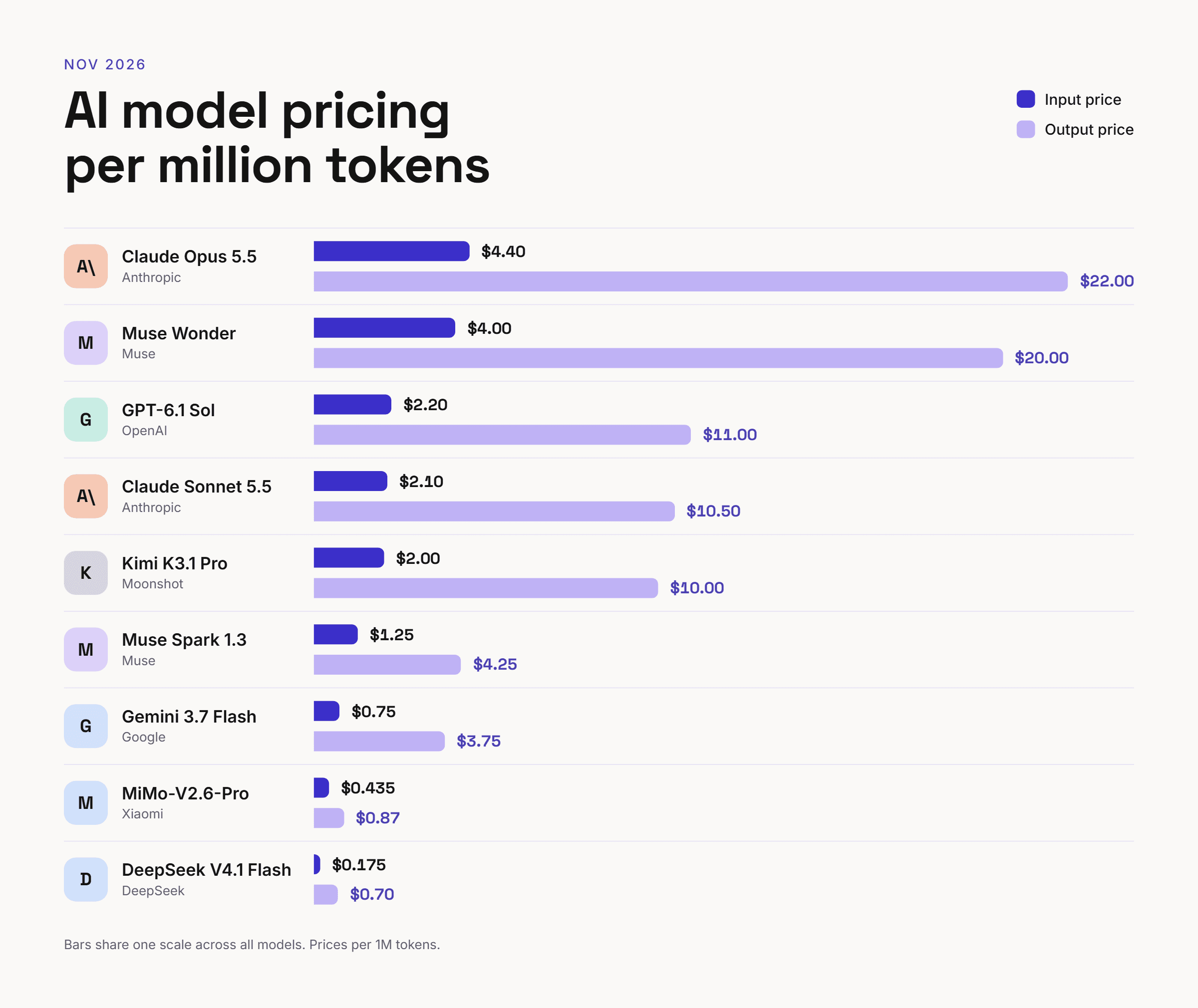
This is what AI model pricing looks like in November 2026. Historically, most AI model providers have followed a straightforward pricing structure, charging separately for input and output tokens.
Input tokens include prompts, instructions, conversation history, and documents sent to a model. Output tokens include generated responses and, for some models, additional billable reasoning tokens.
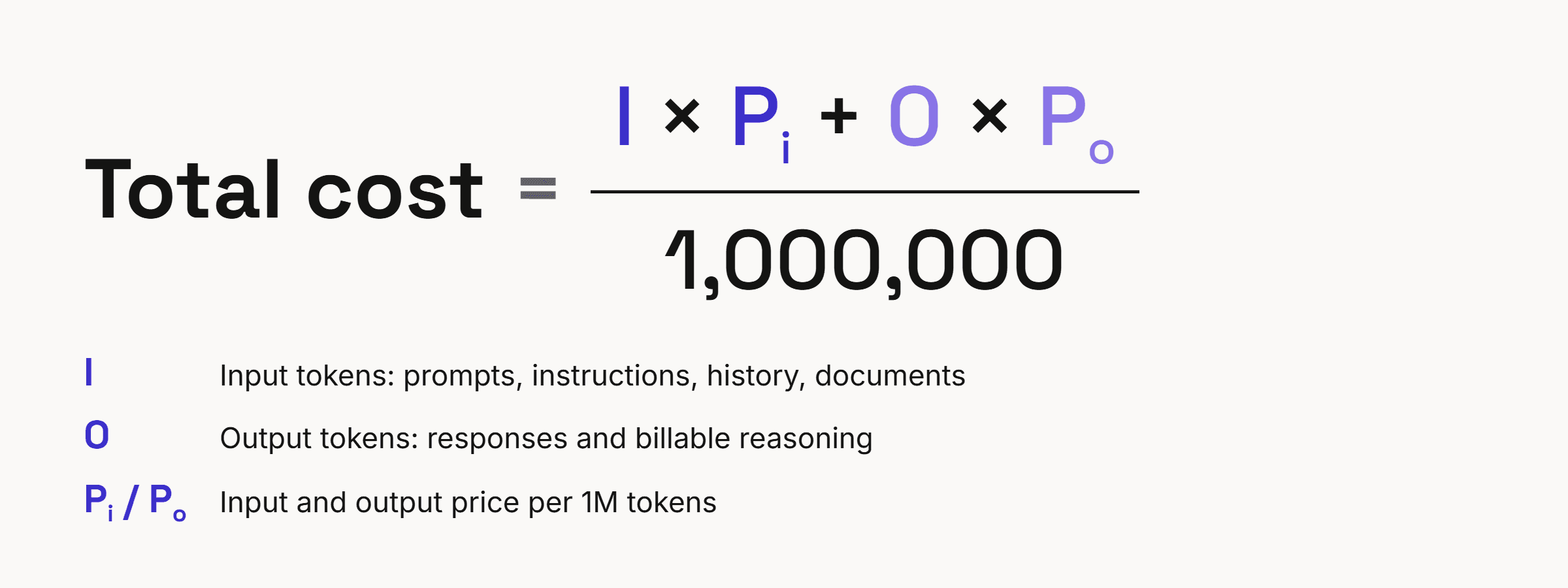
For example, consider an application processing 10 million input tokens and generating 2 million output tokens.
Using Claude Sonnet 5.5:
Input: 10 × $2.10 = $21
Output: 2 × $10.50 = $21
Total: $42
Using Claude Opus 5.5, the same token volume would cost $88.
But with hundreds of AI models available, different hosting providers, batch processing, cached token pricing, and reasoning-token charges, comparing AI model costs has become more complicated.
We analyzed AI models from BestHunt's November 2026 dataset to understand how pricing differs across models and providers. Here's what we found.
AI model pricing per million tokens at a glance
The table below compares selected models from OpenAI, Anthropic, Google, Meta, DeepSeek, MoonshotAI, Xiaomi, and Mistral.
All prices are in US dollars per million tokens.
AI model | Input / 1M | Output / 1M | Arena Elo |
|---|---|---|---|
Claude Opus 5.5 | $4.40 | $22.00 | 1381 |
Muse Wonder | $4.00 | $20.00 | 1380 |
Claude Sonnet 5.5 | $2.10 | $10.50 | 1359 |
GPT-6.1 Sol | $2.20 | $11.00 | 1356 |
Kimi K3.1 Pro | $2.00 | $10.00 | 1355 |
Muse Spark 1.3 | $1.25 | $4.25 | 1341 |
Gemini 4 Argon | $2.10 | $10.50 | 1337 |
MiMo-V2.6-Pro | $0.435 | $0.870 | 1318 |
Gemini 3.7 Flash | $0.750 | $3.750 | 1298 |
DeepSeek V4.1 Flash 1017 | $0.175 | $0.700 | 1281 |
Claude Haiku 5.5 | $0.105 | $0.525 | 1269 |
Mistral Large 4 | $0.735 | $2.205 | 1244 |
AI model pricing comparison by provider
OpenAI pricing
OpenAI's November 2026 model lineup covers a wide range of price points.
OpenAI model | Input / 1M | Output / 1M |
|---|---|---|
GPT-6 Luna | $0.105 | $0.525 |
GPT-6.1 Terra | $1.10 | $5.50 |
GPT-6 Sol | $2.10 | $10.50 |
GPT-6.1 Sol | $2.20 | $11.00 |
GPT-6 Astra | $10.50 | $52.50 |
The rates for GPT-6 Astra are 100 times those of GPT-6 Luna for both input and output tokens. That makes model-tier selection a significant cost decision, even when staying with the same provider.
GPT-6 Sol and GPT-6.1 Sol, by comparison, are priced much closer together. The newer Sol model costs approximately 4.8% more per token.
Anthropic Claude pricing
Claude model | Input / 1M | Output / 1M | Arena Elo |
|---|---|---|---|
Claude Haiku 5.5 | $0.105 | $0.525 | 1269 |
Claude Sonnet 5.5 | $2.10 | $10.50 | 1359 |
Claude Opus 5.5 | $4.40 | $22.00 | 1381 |
Claude Haiku 5.5 costs 95% less per token than Sonnet 5.5.
Sonnet, in turn, costs approximately 52% less than Opus. The differences make it worth evaluating separate models for different task categories rather than routing every request to the most expensive model.
However, the overall Arena Elo differences are substantial between Haiku and Sonnet. Any cost-saving decision should therefore account for changes in task accuracy, retries, and output quality.
Google Gemini pricing
Gemini model | Input / 1M | Output / 1M | Arena Elo |
|---|---|---|---|
Gemini 3.7 Flash | $0.750 | $3.750 | 1298 |
Gemini 4 Argon | $2.10 | $10.50 | 1337 |
Gemini Omni 1.2 Flash | $1.50 | $9.00 | — |
Gemini 4 Argon costs 2.8 times as much as Gemini 3.7 Flash for both input and output tokens. Its Arena Elo is 39 points higher, although that doesn't mean every application will benefit equally from the more expensive model.
Gemini Omni 1.2 Flash supports multimodal inputs. For image- and video-heavy applications, the text-token prices shown here may not capture the full bill.
DeepSeek pricing
DeepSeek model | Input / 1M | Output / 1M |
|---|---|---|
DeepSeek V4.1 Flash 1017 | $0.175 | $0.700 |
DeepSeek V4.1 Flash | $0.210 | $0.900 |
DeepSeek V4 Pro 0813 | $1.320 | $3.960 |
DeepSeek V4.1 Flash 1017 Batch | $0.011 | $0.200 |
DeepSeek's lower-priced models are relevant for applications where API cost is a major constraint. The batch variant of DeepSeek V4.1 Flash 1017 has a much lower listed input rate than its standard version. Its output rate is also lower.
Other competitive models
Model | Input / 1M | Output / 1M | Arena Elo |
|---|---|---|---|
Muse Wonder | $4.00 | $20.00 | 1380 |
Muse Spark 1.3 | $1.25 | $4.25 | 1341 |
Kimi K3.1 Pro | $2.00 | $10.00 | 1355 |
MiMo-V2.6-Pro | $0.435 | $0.870 | 1318 |
Mistral Large 4 | $0.735 | $2.205 | 1244 |
Qwen3.7 Plus | $0.320 | $1.280 | 1236 |
How much do AI models cost for the same workload?
A price-per-million-token comparison becomes more useful when we apply it to an actual workload. For this analysis, we calculated the cost of processing 10 million input tokens and generating 2 million output tokens using standard API pricing.
The same token volumes are applied to every model, allowing us to isolate differences in advertised rates.
AI model | Input cost | Output cost | Total cost |
|---|---|---|---|
Claude Opus 5.5 | $44.00 | $44.00 | $88.00 |
Muse Wonder | $40.00 | $40.00 | $80.00 |
GPT-6.1 Sol | $22.00 | $22.00 | $44.00 |
Claude Sonnet 5.5 | $21.00 | $21.00 | $42.00 |
Kimi K3.1 Pro | $20.00 | $20.00 | $40.00 |
Muse Spark 1.3 | $12.50 | $8.50 | $21.00 |
Gemini 3.7 Flash | $7.50 | $7.50 | $15.00 |
MiMo-V2.6-Pro | $4.35 | $1.74 | $6.09 |
DeepSeek V4.1 Flash 1017 | $1.75 | $1.40 | $3.15 |
Claude Haiku 5.5 | $1.05 | $1.05 | $2.10 |
From the data table we can see, Claude Opus 5.5 costs $88 for this workload, while Claude Sonnet 5.5 costs $42 and Muse Spark 1.3 costs $21.
MiMo-V2.6-Pro costs $6.09, approximately 93% less than Opus.
However, the lower-priced models have different overall quality scores. The cost difference alone doesn't establish whether they can complete the same tasks to the same standard.
Among models with closer overall ratings, the price gap is smaller. Claude Sonnet 5.5, GPT-6.1 Sol, and Kimi K3.1 Pro have Arena Elo scores of 1359, 1356, and 1355, respectively. Their estimated workload costs range from $40 to $44.
For these models, task-specific performance and operational requirements may matter more than the relatively small difference in listed token rates.
Which AI models have the lowest token prices?
Some of the lowest-priced models in BestHunt's November dataset have input rates below $0.05 per million tokens.
AI model | Input / 1M | Output / 1M |
|---|---|---|
DeepSeek Flash Latest | $0.006 | $0.500 |
Ling 3.0 Tiny | $0.015 | $0.045 |
Nex-N2.5-Mini | $0.025 | $0.100 |
Mistral Nemo | $0.029 | $0.030 |
Qwen3.7 Flash | $0.03225 | $0.13975 |
GLM Flash Latest | $0.0335 | $0.083 |
The lowest input price doesn't necessarily translate into the lowest total cost. DeepSeek Flash Latest has a listed input rate of $0.006 per million tokens, but its output rate is $0.50.
Mistral Nemo has a higher input rate of $0.029, but output costs only $0.030.
For our 10-million-input, 2-million-output workload, DeepSeek Flash Latest would cost $1.06, while Mistral Nemo would cost $0.35.
Mistral Nemo is approximately 67% cheaper for this workload, despite having a substantially higher input rate.
Neither model has an Arena Elo score in the supplied dataset, so this comparison is limited to pricing.
How batch processing changes AI model costs
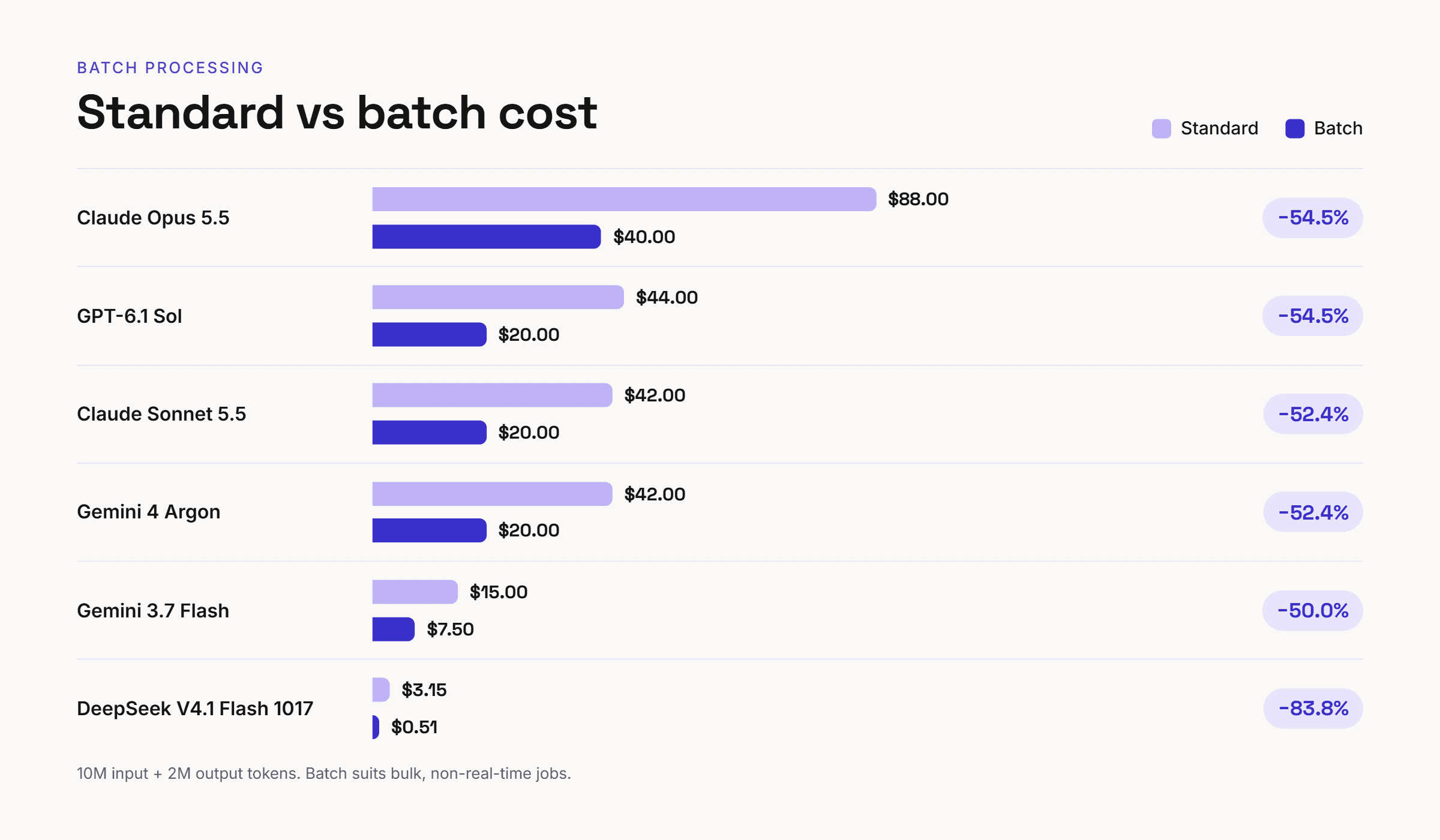
Batch processing allows developers to submit requests for asynchronous execution, often at lower token rates.
The following table compares the standard and batch costs of processing 10 million input tokens and generating 2 million output tokens.
Model | Standard cost | Batch cost | Savings |
|---|---|---|---|
Claude Opus 5.5 | $88.00 | $40.00 | 54.5% |
GPT-6.1 Sol | $44.00 | $20.00 | 54.5% |
Claude Sonnet 5.5 | $42.00 | $20.00 | 52.4% |
Gemini 4 Argon | $42.00 | $20.00 | 52.4% |
Gemini 3.7 Flash | $15.00 | $7.50 | 50.0% |
DeepSeek V4.1 Flash 1017 | $3.15 | $0.51 | 83.8% |
The largest percentage reduction in this selected comparison comes from DeepSeek V4.1 Flash 1017, where the cost falls from $3.15 to $0.51. Claude Opus 5.5 falls from $88 to $40, while Claude Sonnet 5.5 falls from $42 to $20.
These savings are relevant for scheduled document analysis, bulk classification, data enrichment, and offline evaluations.
However, batch processing isn't suitable for every application. Real-time assistants and interactive tools may require immediate responses, making standard API processing necessary.
How much can prompt caching reduce the bill?
Caching provides another way to reduce API costs without switching models. When an application repeatedly sends eligible content to a model, cached input tokens can be billed at discounted rates.
Among all the models with reported cache-saving percentages in our dataset, the median discount is 90%. However, this discount applies to eligible cached input, not to the entire API bill.
For example, Claude Sonnet 5.5 has a standard input rate of $2.10 per million tokens and a cached-input rate of $0.10.
For our 12-million-token workload, the modeled cost changes as follows:
Cached share of input | Total API cost | Savings |
|---|---|---|
0% | $42.00 | 0% |
25% | $37.00 | 11.9% |
50% | $32.00 | 23.8% |
75% | $27.00 | 35.7% |
100% | $22.00 | 47.6% |
At a 50% input cache-hit rate, the bill falls from $42 to $32. Even at a 100% input cache-hit rate, the modeled cost remains $22 because output tokens are still charged at their normal rate.
Actual savings also depend on cache eligibility, expiration, cache-writing costs, and the proportion of repeated input.
How to choose an AI model based on pricing
The rule of thumb is always to evaluate models according to the type of work you need to perform.
Workload | Models to evaluate | What to measure |
|---|---|---|
High-volume classification | Claude Haiku 5.5, Qwen3.7 Flash | Accuracy and cost per task |
General-purpose applications | Claude Sonnet 5.5, GPT-6.1 Sol, Kimi K3.1 Pro | Quality, latency, total cost |
Complex reasoning and coding | Claude Opus 5.5, Sonnet 5.5 | Completion rates and retries |
Offline bulk processing | Batch variants | Discounts and completion time |
Repeated long-context tasks | Models with caching support | Cache-hit rates and total cost |
Cost-sensitive inference | MiMo-V2.6-Pro, DeepSeek variants | Price, reliability, and quality |
For simple, high-volume tasks, we would start by testing lower-priced models.
For general-purpose applications, we would compare models with relatively close overall quality ratings using the same evaluation set.
For complex reasoning, coding, and agentic workflows, we would include premium models and measure whether their additional capabilities justify the higher cost.
We would also evaluate caching and batch processing before switching models, because these options can reduce costs without changing the underlying model.
Explore the latest pricing and model comparisons on BestHunt AI Models.

About the author
Nishrath
Nishrath is a content marketer for SaaS companies in the marketing and productivity space. Outside of work, she enjoys reading books and is always trying to learn new languages.

