We Analyzed AI Startup Shutdowns. Here’s What Went Wrong

By Nishrath
Over the last two years, the pace of AI software development has changed remarkably.
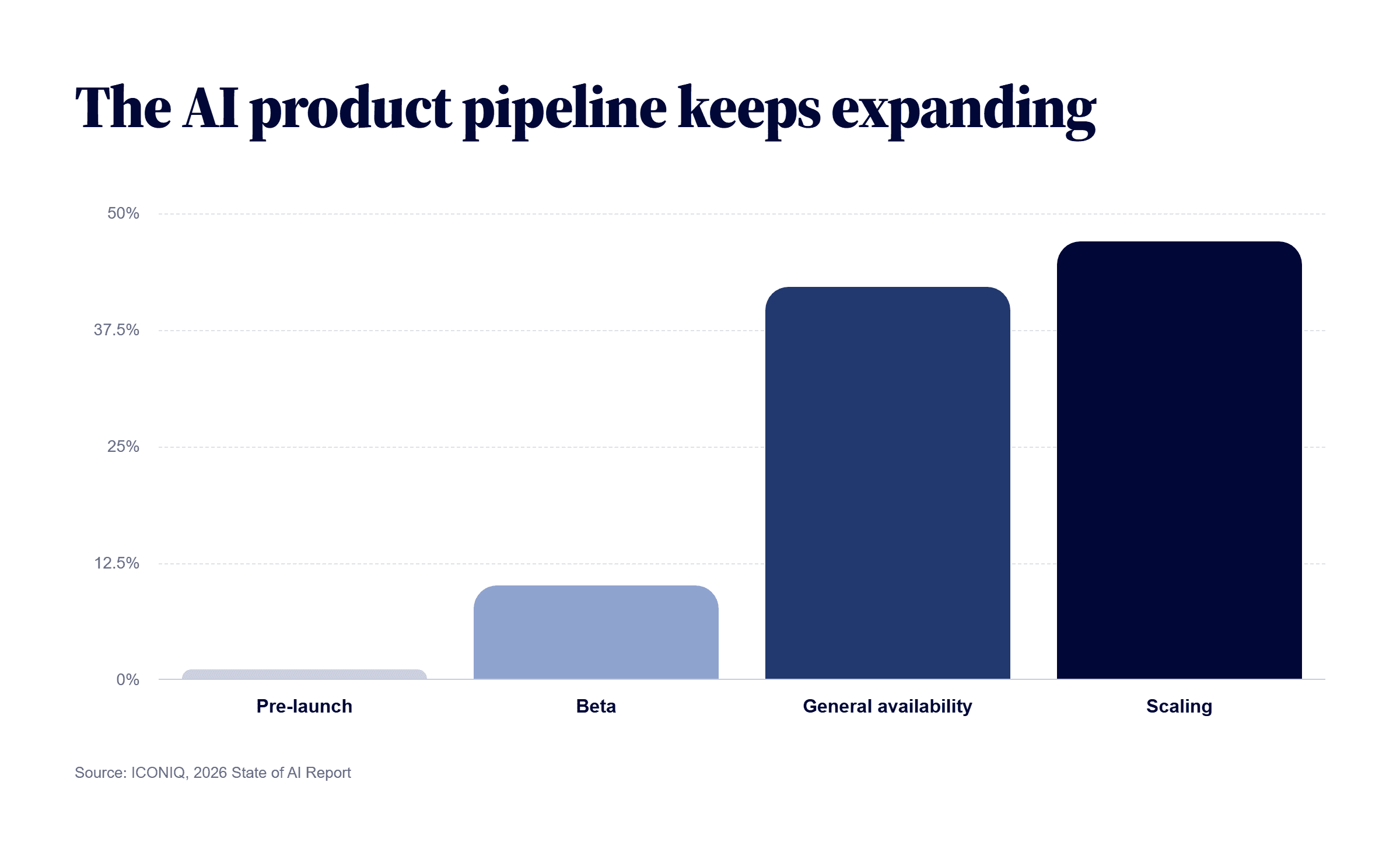
In 2025, the market was already moving toward building and scaling actual AI products.
47% of AI-native products in ICONIQ's survey were already in the scaling stage, meaning they had moved beyond launch and had demonstrated product-market fit.
In 2026, the bar is even higher. ICONIQ found that organizations had an average of three AI products already in production, with another two expected to reach production within the next 12 months.
But as more AI products are built, competition grows with them, and so do the chances of survival.
In this analysis, we looked at a dozen AI startups that shut down over the last two years to understand why they failed, even when some had millions of users, enterprise customers, or meaningful revenue.
Find 1: User growth didn’t translate into strong commercial PMF
Product-market fit is often reduced to a simple question “do users love the product? ”
But that becomes more complicated in a two-sided marketplace. A two-sided marketplace requires a 2 side PMF where growth on one side should create more value for the other side, which then strengthens the marketplace.
And for Yupp.ai that loop wasn't strong enough. Here is how it worked
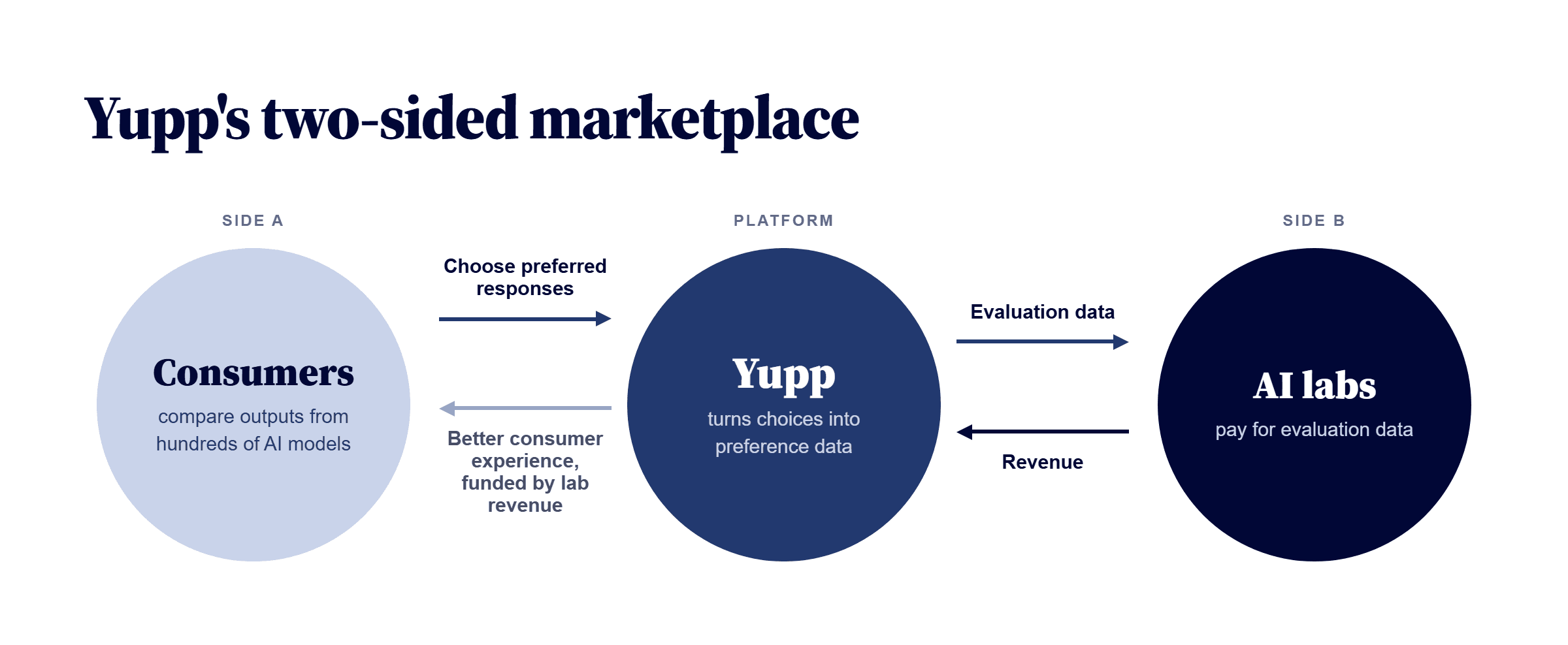
Yupp clearly found substantial demand on the consumer side with 1.3 million users. But it was struggling to produce sufficiently valuable evaluation data that ultimately translated into repeatable revenue from AI labs.
“This was because AI usage has moved beyond just specific model usage to connected agentic workflows,” said the founder.
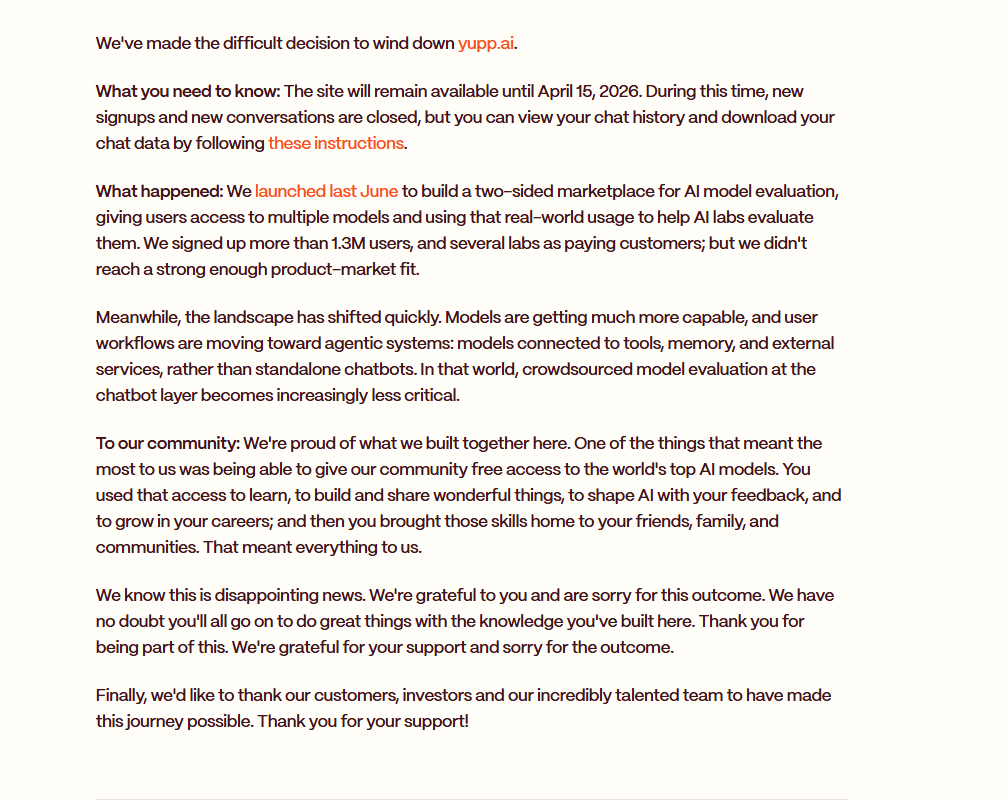
Yupp's original unit of evaluation a user could compare Model A's response with Model B's response and indicate which one was better.
But now :
Model + tool calling + search + memory + retrieval + application logic + external software → final outcome
That requires a different kind of evaluation infrastructure. And Yupp's original consumer-ranking system was therefore becoming less aligned with the direction of AI development.
Find 2: Customers found the product useful, but didn’t need it badly enough
One of the most common reasons an AI startup or any startup fails is necessity - does the customer actually need the product badly enough?
And that was the issue with Zeda.io.
Zeda built a product-management platform for collecting customer feedback, generating product insights, and helping product teams turn customer feedback into product decisions.
It had customers and made what founder Prashant Mahajan described as decent money in a podcast.
But the problem was, as Mahajan described, “it was vitamin, not a painkiller.”
There were also plenty of alternatives competing for that same workflow and budget - from dedicated product platforms to tools teams already had, such as Jira, Notion, spreadsheets, and other existing workflows.
A 2025 survey of Youform users gives a useful way to think about why product necessity is important for success, especially for AI projects.
Youform used Sean Ellis's product-market-fit test, which asks users how they would feel if they could no longer use a product. Ellis's benchmark is above 40% of users answering “very disappointed” as a strong signal of a necessary product.
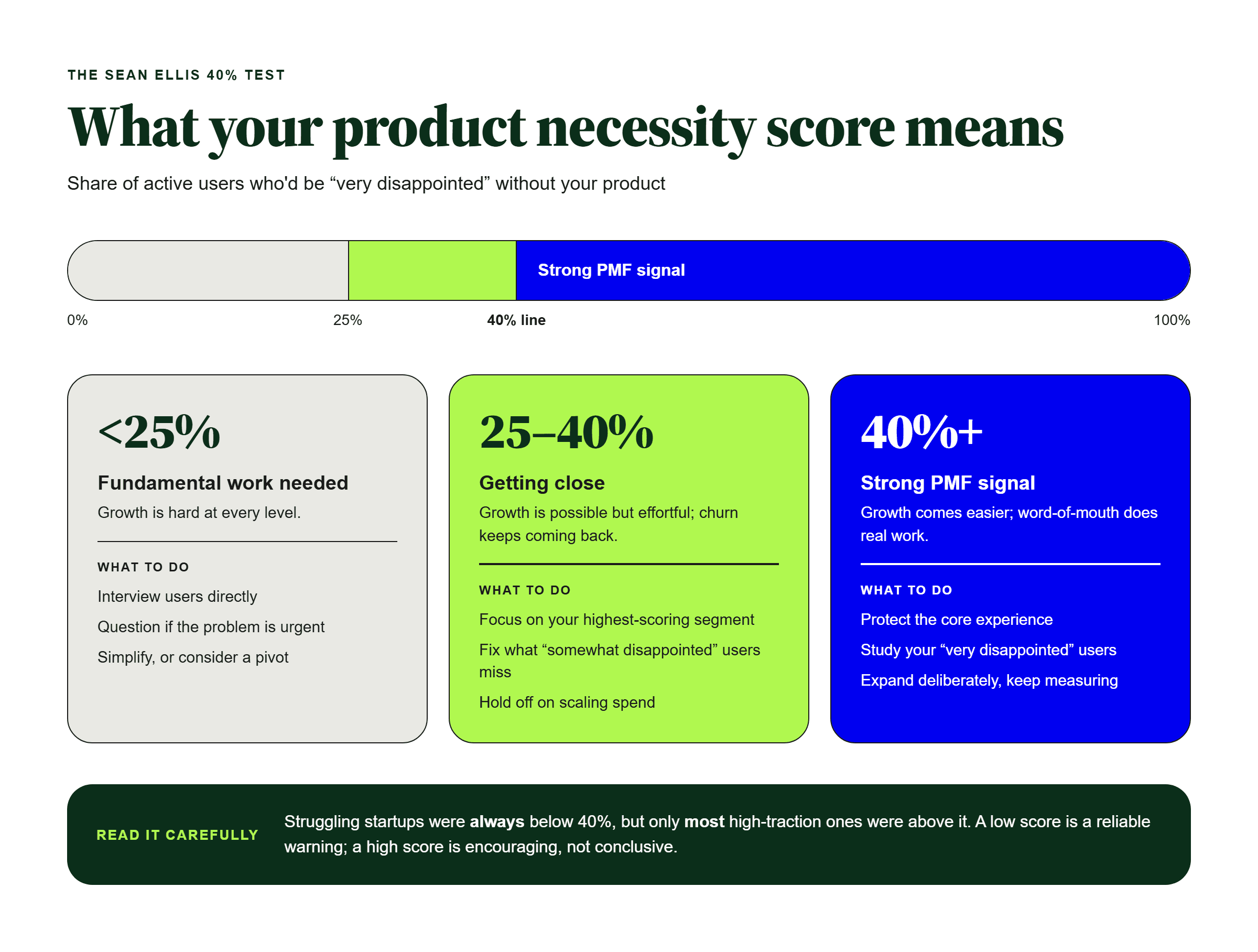
Youform tested it on 183 users. After a week, all users responded, and 64% said they would be “very disappointed” if they could no longer use Youform.
Since last year, Youform has grown from 20,000+ registered users to more than 80,000 users worldwide, while collecting 10M+ responses. That growth reflects that building something customers would genuinely miss can be a much stronger foundation for long-term success.
Find 3: Selling to different markets instead of focusing on one
Subtl.ai had real enterprise customers. The company worked with 20 companies, including defence PSUs, two airports, a U.S. insurtech company, and State Bank of India, according to founder Vishnu Ramesh.
But these customers came from very different markets and had very different use cases. And that went wrong for them.
Subtl had initially set out to build infrastructure for the RAG ecosystem, including document processing, retrieval, and fine-tuned small language models. But as demand came from different customers, the company started solving different problems across different industries.
That made sales difficult to repeat because each market brought different workflows, requirements, and buying needs.
Find 4: Customers weren't willing to change what already worked
Founder Matt Koppenheffer launched QualRank in May 2025 as a platform for comparing AI models on performance and cost. The product had beta users, but Koppenheffer shut it down by late August.
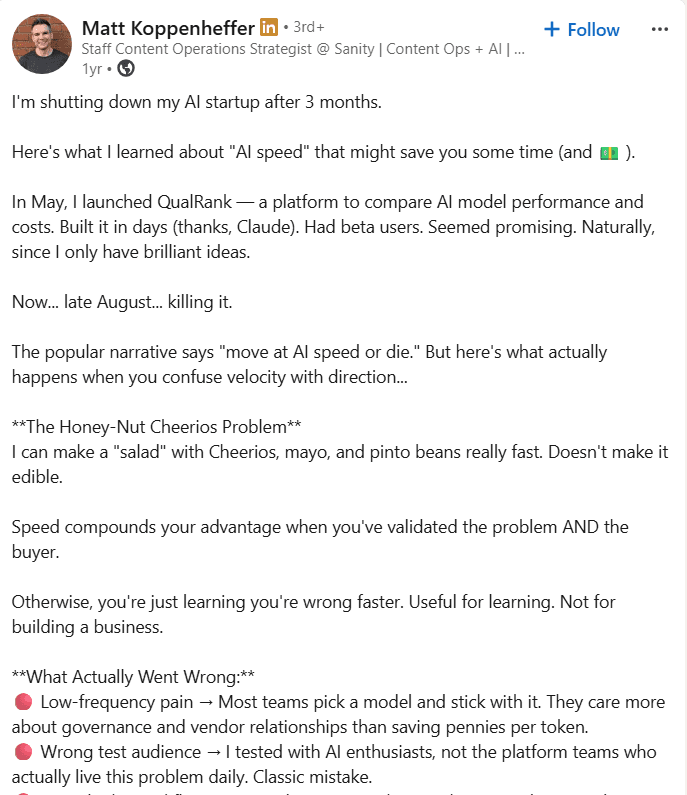
The idea was to help teams figure out which model worked best for a particular task. Early users were AI enthusiasts, but the actual target market was platform teams responsible for the infrastructure and systems where models are deployed and managed.
And even for those teams, this wasn't a decision they needed to make very often.
Koppenheffer found that once teams picked a model, they usually stuck with it. Governance and existing vendor relationships often mattered more than switching models just to get a small improvement in cost or performance.
That's consistent with broader B2B buying behavior. 6sense's 2025 survey found that while nearly half of buyers were at least somewhat likely to consider a different vendor after reaching consensus, only about 20% actually switched.
Find 5: The product was targeting users who didn’t always control the budget
Zeda.io's target users were product managers and product teams. Given how Zeda was targeting early-stage startups to mid-sized companies, founder Prashant Mahajan found that product managers within these companies often didn't control the software budget themselves.
Product Focus's 2024 survey of product professionals supports what Mahajan was seeing: 52% cited lack of resources as a major issue, including budget constraints.
So even when a product manager found Zeda useful, that didn't necessarily justify the purchase to the person who actually controlled the budget.
This distinction changes how founders should think about validation and market size. There might be 100,000 potential product managers, which looks like a large market.
But if many of those PMs:
Don't control software budgets and need their VP, CPO, or CEO to approve new tools
Already have a fixed product-management software budget
Can't introduce another paid tool without replacing an existing one
Then the commercially reachable market is much smaller.
Find 6:Better AI models were reducing the technical gap
ICONIQ's 2026 State of AI report found that companies were using an average of 3.3 models, with licensed third-party APIs the most common model type. Nearly half were using two or more model types.
While fast development, this creates a problem for AI application startups. The same foundation models that make their products possible can improve enough to make parts of those products easier for customers to build themselves.
That became a problem for Reforged Labs.
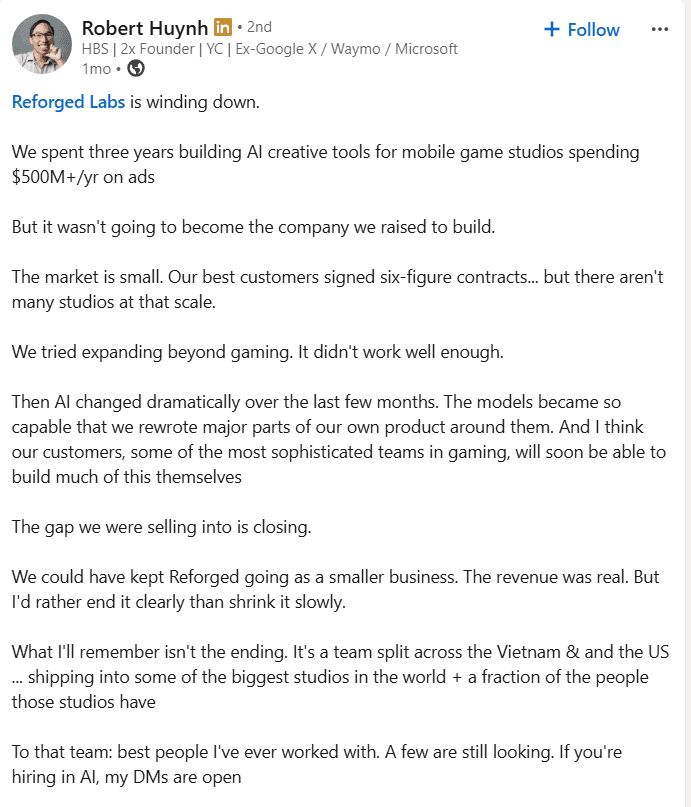
Reforged built AI creative tools for mobile game studios. Founder Robert Huynh said its best customers were signing six-figure contracts, so the company had demonstrated that customers were willing to pay significant amounts for the product.
But while Reforged was building, the underlying AI models were improving rapidly.
Huynh said the models became so capable that Reforged rewrote major parts of its own product around them. But at the same time, it also meant large gaming studios with engineering teams, creative teams, and performance data could build this tool as well.
FAQs
Which tool is best for small businesses?+
Mailmodo, Buffer, and Hootsuite are affordable and user-friendly, making them great for small businesses just starting with digital marketing.
Can I switch tools as my business grows?+
Yes! Most platforms, like HubSpot and SEMrush, offer scalable plans that grow with your business.