AI Hardware Boom: Will Smart Devices Be Commoditized?

By Nishrath
For most of the generative AI boom, the focus has been on software: foundation models, chatbots, coding assistants, and AI agents. Hardware has largely been discussed as the infrastructure needed to support them, from Nvidia GPUs to the data centers running increasingly demanding workloads.
But there is another side to the hardware opportunity: physical products that use AI to understand their surroundings, interpret information, and perform tasks.
Smart glasses can interpret what users see.
Wearable recorders can capture conversations and turn them into searchable notes.
Robots can use perception models to navigate physical environments.
Other devices promise to make AI available without requiring users to open a laptop or smartphone application.
The technological conditions for these products are improving significantly.
According to Stanford University's 2025 AI Index, the cost of running an AI model at approximately GPT-3.5's benchmark performance fell from $20 per million tokens in November 2022 to $0.07 in October 2024.
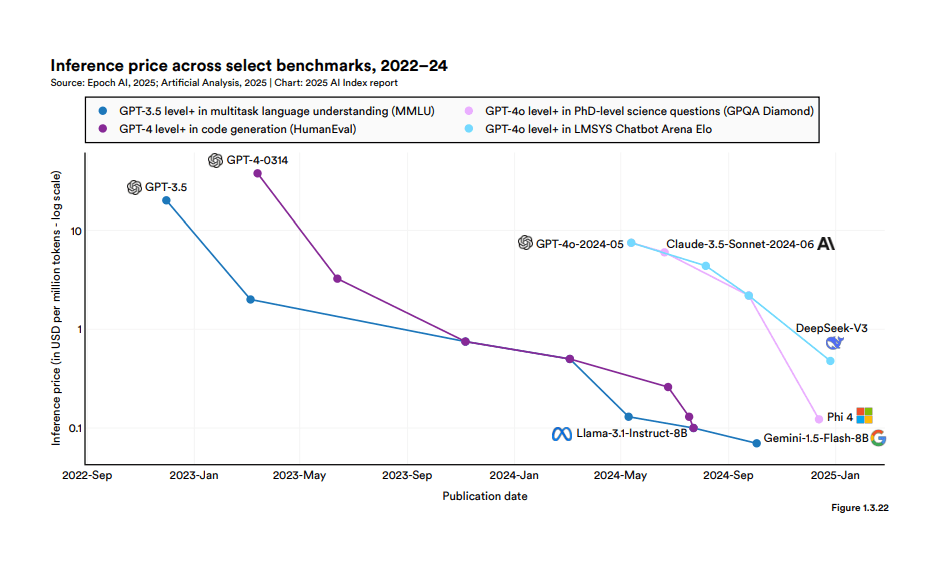
The same report estimated that machine-learning hardware price-performance improved by approximately 30% annually, while energy efficiency improved by about 40% annually.
These improvements make more AI-powered device applications technically and economically feasible, although they do not directly measure consumer-device manufacturing costs.
But lower technology costs do not guarantee profitable hardware businesses.
We examined the market to understand where it might be heading, whether AI hardware is becoming commoditized as some expect, and what could still make these businesses defensible.
Prototyping has become much easier, but manufacturing is still a long way to go
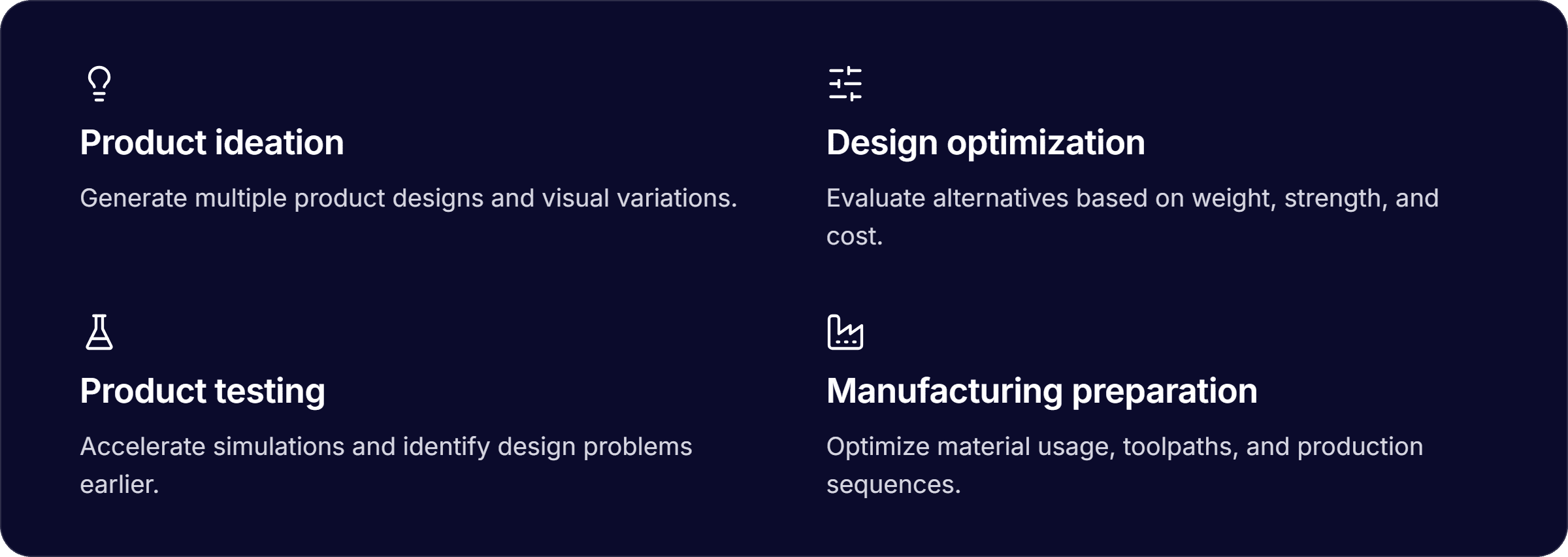
Developing hardware requires design, engineering, prototyping, testing, and manufacturing preparation. AI-assisted tools can reduce the time required for some of these activities.
A December 2025 analysis by Figr identifies four areas where AI can accelerate development:
The expected time reductions are said to be:
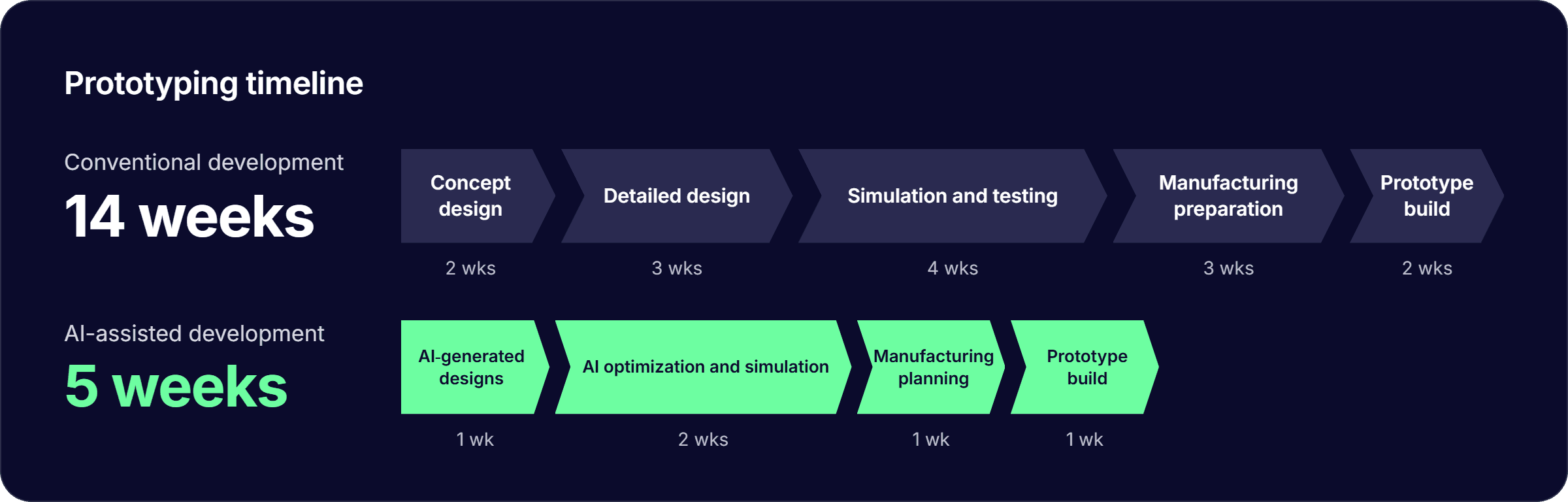
While shorter development cycles could allow startups to test product concepts with less time and capital, this could increase competition, particularly when manufacturers use similar AI models, processors, and sensors.
However, creating a prototype is different from producing a commercially ready device. Manufacturers still need to secure components, meet regulatory requirements, maintain quality, finance inventory, and manage distribution.
Running AI locally could reduce costs, but it adds engineering challenges
AI hardware manufacturers must decide whether to process information in the cloud or directly on their devices. That decision affects both manufacturing expenses and ongoing operating costs.
On-device AI could reduce recurring expenses. Processing requests locally can lower cloud inference costs, improve response times, and enable offline functionality.
A 2025 USENIX study reported inference acceleration of up to 11.92 times and energy savings of up to 7.36 times in its experimental configurations, demonstrating the potential of optimized local processing.
But local processing can also increase manufacturing costs, as it requires capable processors, memory, battery capacity, and workforce to manage it.
Meanwhile, cloud inference has other advantages. Manufacturers can access increasingly powerful models without installing expensive computing hardware in every product.
A hybrid approach is what we are seeing going forward. For devices processing frequent requests, local AI could offer savings. For devices requiring advanced models or handling fewer requests, cloud processing may remain more economical.
Building devices may become easier, but established brands still have an advantage in selling them
Manufacturing an intelligent device does not guarantee customers will buy it.
Hardware companies need distribution channels, marketing, customer support, and systems for managing returns and warranties. Established manufacturers often have these capabilities before introducing AI.
The smart-glasses market provides an example.
In 2019, Canadian startup North introduced Focals, smart glasses that displayed notifications and navigation information. The company had raised nearly $200 million, but selling the product proved difficult.
Focals initially required customers to visit one of just two fitting locations, in Toronto or New York. The glasses launched at $999 before North reduced the price to $600. The company eventually discontinued Focals, canceled its second-generation product, and was acquired by Google in 2020.
Years later, Meta and EssilorLuxottica approached smart glasses differently. Instead of creating a new eyewear brand and distribution network, they integrated AI into Ray-Ban and Oakley products.
The partnership sold more than 7 million AI glasses in 2025, according to EssilorLuxottica.
The comparison suggests that established brands can have an advantage in bringing intelligent hardware to market. North had to build the product and develop a way to sell and fit it. EssilorLuxottica already had eyewear brands, manufacturing expertise, and retail relationships.
However, the sales figure does not establish the profitability of AI glasses or prove that established manufacturers will dominate every category.
Making a useful product matters even more when customers have to buy another device
Voice assistants, transcription, summarization, and information retrieval are already available through smartphones. Standalone AI products like pendants and recording devices must therefore provide enough additional value to justify another purchase.
That could involve hands-free operation, continuous sensing, faster access, or specialized functionality that smartphones cannot deliver as conveniently.
A 2025 study published in Technological Forecasting and Social Change, involving 629 US users, found that perceived intelligence, ease of use, and design aesthetics positively influenced acceptance of AI-powered eyewear. Privacy concerns had a negative relationship with acceptance.
The challenge also extends beyond the initial purchase.
In February 2025, Humane discontinued its AI Pin. Launched at $699 with a $24 monthly subscription, the device promised a screen-free alternative to smartphones. However, reviews highlighted slow responses, unreliable AI features, overheating, and difficulty completing everyday tasks that smartphones already handled more efficiently.
Going general or going specialised?
Whether a company builds a general-purpose device or one designed for a specific task could significantly influence its competition, costs, and chances of commercial success.
For example, health wearables could be more difficult to replace with smartphone applications. Oura differentiates itself through dedicated sensors that continuously track physiological signals such as temperature, heart rate, and sleep patterns.
While smartphones can analyze health information, they cannot independently collect the same continuous data without additional hardware.
On the other hand, standalone AI devices such as Friend's pendant and Rabbit R1 offer capabilities that overlap considerably with smartphone applications such as voice interaction.
This makes competition more difficult for general-purpose hardware. Manufacturers must convince customers that the convenience of a dedicated device is worth the additional purchase, even when similar functionality is available elsewhere.
Specialized hardware may have a stronger advantage because its value comes from capabilities that are harder to reproduce through software alone. However, dedicated sensors, complex components, and specialized manufacturing can also increase production and maintenance costs.
Final thoughts
As demand grows and production becomes easier, we can expect more manufacturers to enter the market. That should increase competition, expand consumer choice, and eventually put pressure on prices.
But we don't think the benefits of this growth will be distributed equally.
Established manufacturers have an advantage in production volumes, supplier relationships, and distribution. They can negotiate better component prices, spread fixed costs across more units, and reach customers without building an entirely new sales network.
Smaller companies may struggle to match those economics, even if they develop better products. Some will likely have to compete in specialized markets where customers are willing to pay more for specific capabilities.
We are also interested in where the profits will accumulate.
If manufacturers increasingly rely on the same chipmakers, foundation models, operating systems, and manufacturing partners, the companies supplying those technologies could capture a significant share of the market's value. Device makers, meanwhile, may face increasing competition while depending on suppliers they have limited power to negotiate with.
FAQs
Which tool is best for small businesses?+
Mailmodo, Buffer, and Hootsuite are affordable and user-friendly, making them great for small businesses just starting with digital marketing.
Can I switch tools as my business grows?+
Yes! Most platforms, like HubSpot and SEMrush, offer scalable plans that grow with your business.