How Much More Do Marketing Tools Charge for AI Features?

By Chithra
Ask a marketer whether their tools charge extra for AI, and most will say “a bit, probably.” Ask how much, and the answer gets vague. That vagueness is not the marketer’s fault.
Vendors are still working out how to charge for AI, and many are trying several models at once. In Nalpeiron’s 2026 State of B2B Software Monetization survey of 255 software companies, 66% meter AI by usage, 52% sell credit or token bundles and 49% fold it into per-seat plans, while 27% have AI features they do not charge for separately at all.
We looked at what five widely used marketing tools charge for AI. The extra cost ranged from $0 to more than double the base subscription.
But the price matters less than the pattern behind it. Vendors give away AI that is cheap to run. They charge more for AI that does real work. And some now sell AI as something you can measure. Here’s what that looks like in each tool.
Methodology
We read the public pricing pages of one widely used tool from each corner of the marketing stack. We picked them because each represents a different way of charging for AI: included, gated behind a tier, sold as credits, billed per agent task, and sold as a product of its own.
Tool | Category | Extra cost for AI | Pricing model |
|---|---|---|---|
Buffer | Social media | $0 | Included in every plan, including Free |
Mailchimp | Email marketing | +54% entry price | Only on higher tiers |
Adobe | Creative | $9.99 to $199.99 a month | Monthly allowance, then credit packs |
Klaviyo | Marketing automation | From $20 a month (Composer); $112 for 160 agent conversations | AI agents billed by usage |
Semrush | SEO | +41% over the SEO-only plan | AI search tracking sold as its own tier |
Finding #1: Basic AI is now a standard feature
Every vendor we studied offers some AI without a separate add-on.
Buffer makes the point most clearly its AI Assistant is on Free, Essentials ($5 per channel a month, billed yearly) and Team ($10). Upgrades buy posts, seats and workflows, not AI. In other words, the AI premium on Buffer is $0. And this isn’t a short-term promotion: a June 2025 snapshot of Buffer’s pricing shows the same setup.
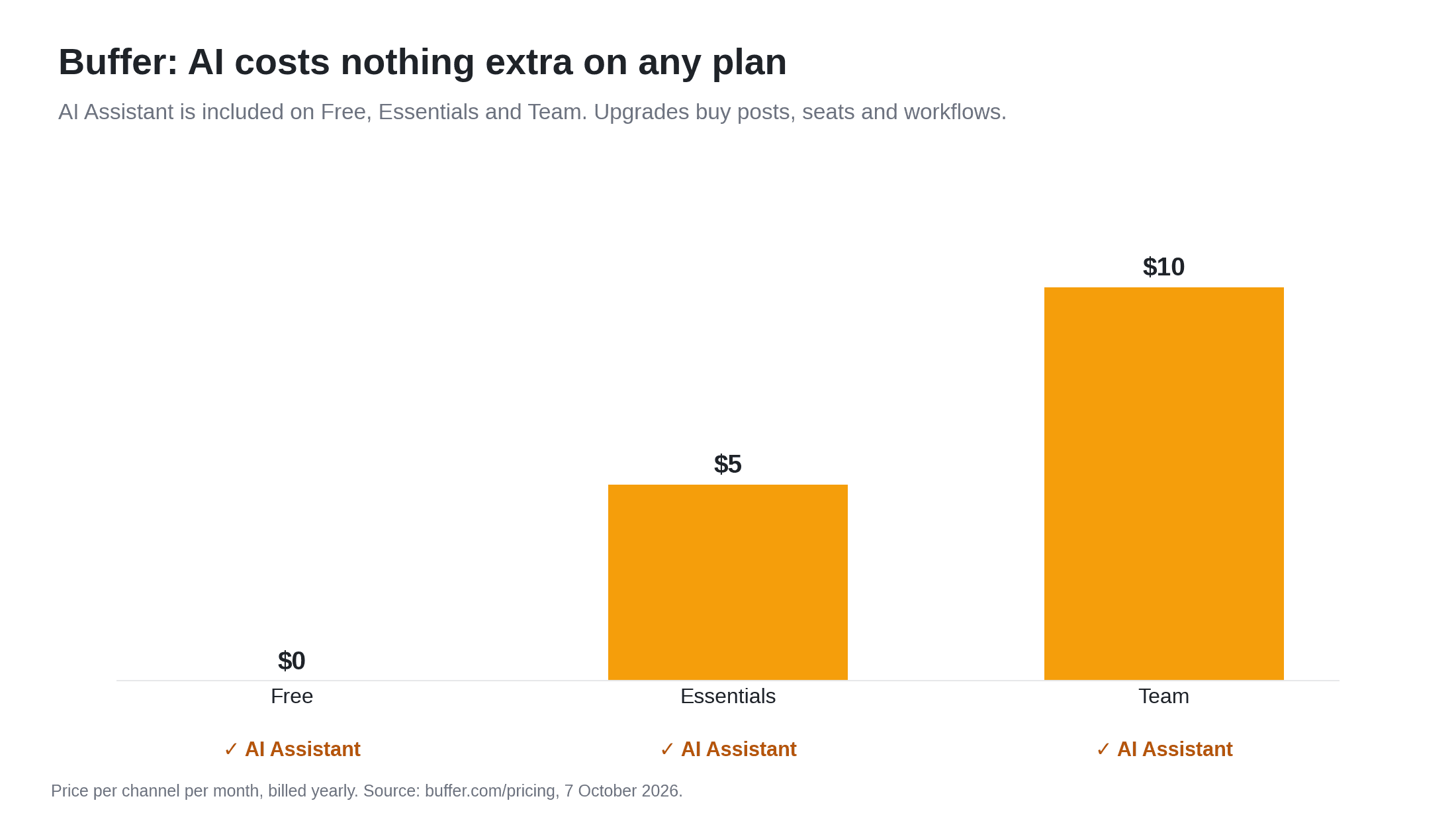
Why give AI away? Because it costs Buffer very little. Generating a caption is cheap to run, and charging for it would only add friction for users.
So Buffer charges for something else: the number of social channels you connect. Channels are easy to count, every customer understands them, and they grow as a business grows. That leaves AI with a different job. It makes the product more useful, which keeps people subscribed, while channels bring in the revenue.
Finding #2: Some vendors still gate AI behind a higher tier
Mailchimp offers generative AI at no additional cost on its higher plans, Standard and Premium. Its basic small-business plan, Essentials, has no AI at all, and there is no add-on to buy. To get AI, you have to move up to Standard, which starts at $20 a month instead of $13.
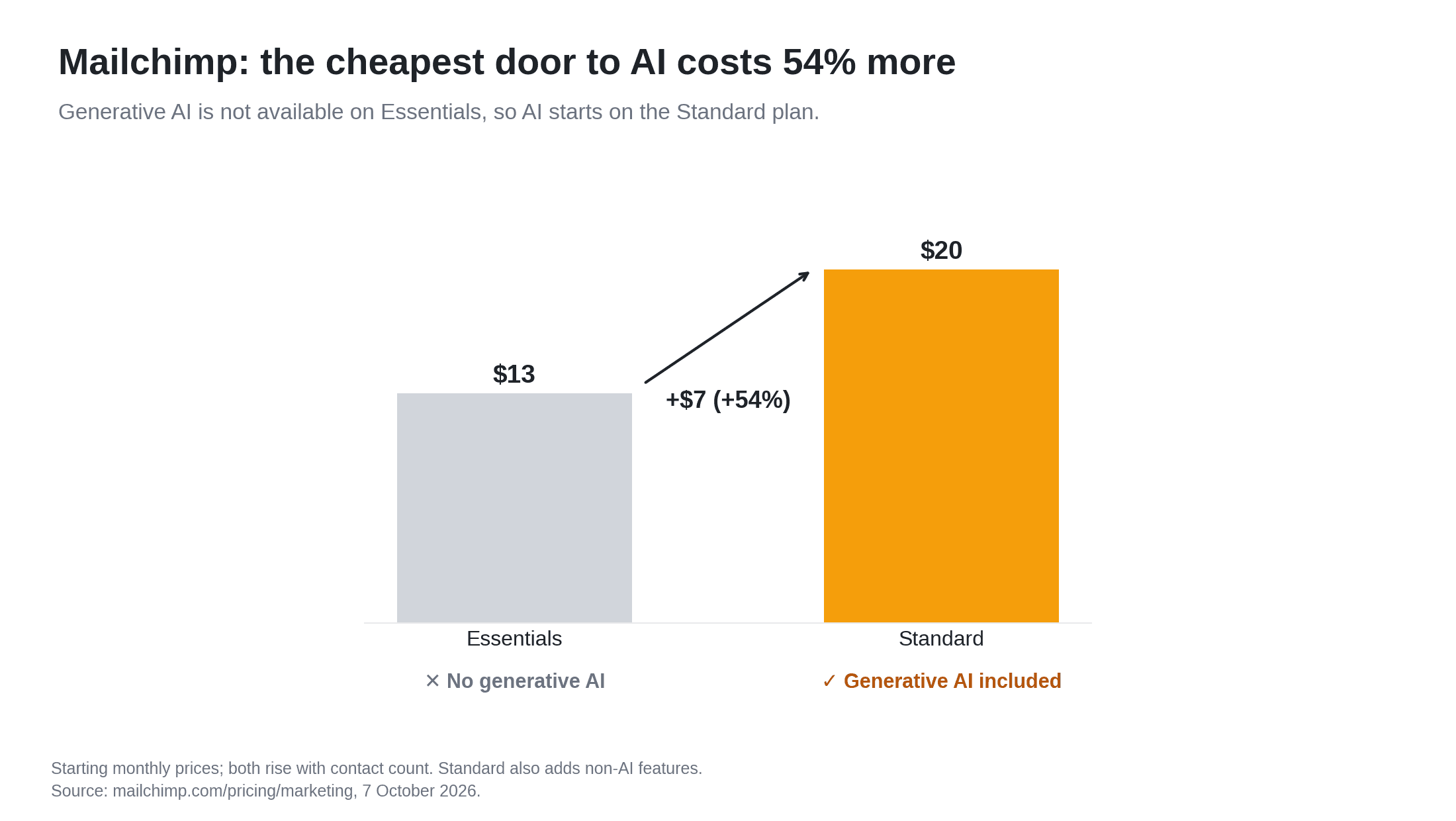
That 54% is not necessarily an AI fee only. Standard also adds up to 200 automation flows, custom reports, dynamic content, and more seats. What AI plays is a marketing role to upgrade.
But if you would move to Standard anyway for automation or reporting, Mailchimp’s AI is effectively free. If you would not, the extra $7 a month is the real price of AI, and you pay it partly for features you may never use.
Finding #3: Heavier AI use is billed by volume
Adobe shows what happens when AI use gets heavy. Its Creative Cloud Pro plan costs $69.99 a month and comes with a monthly allowance of generative credits. Once those run out, you buy credit packs. They cost $9.99 to $199.99 a month, which works out to about 40 to 50 cents for each five-second AI video.
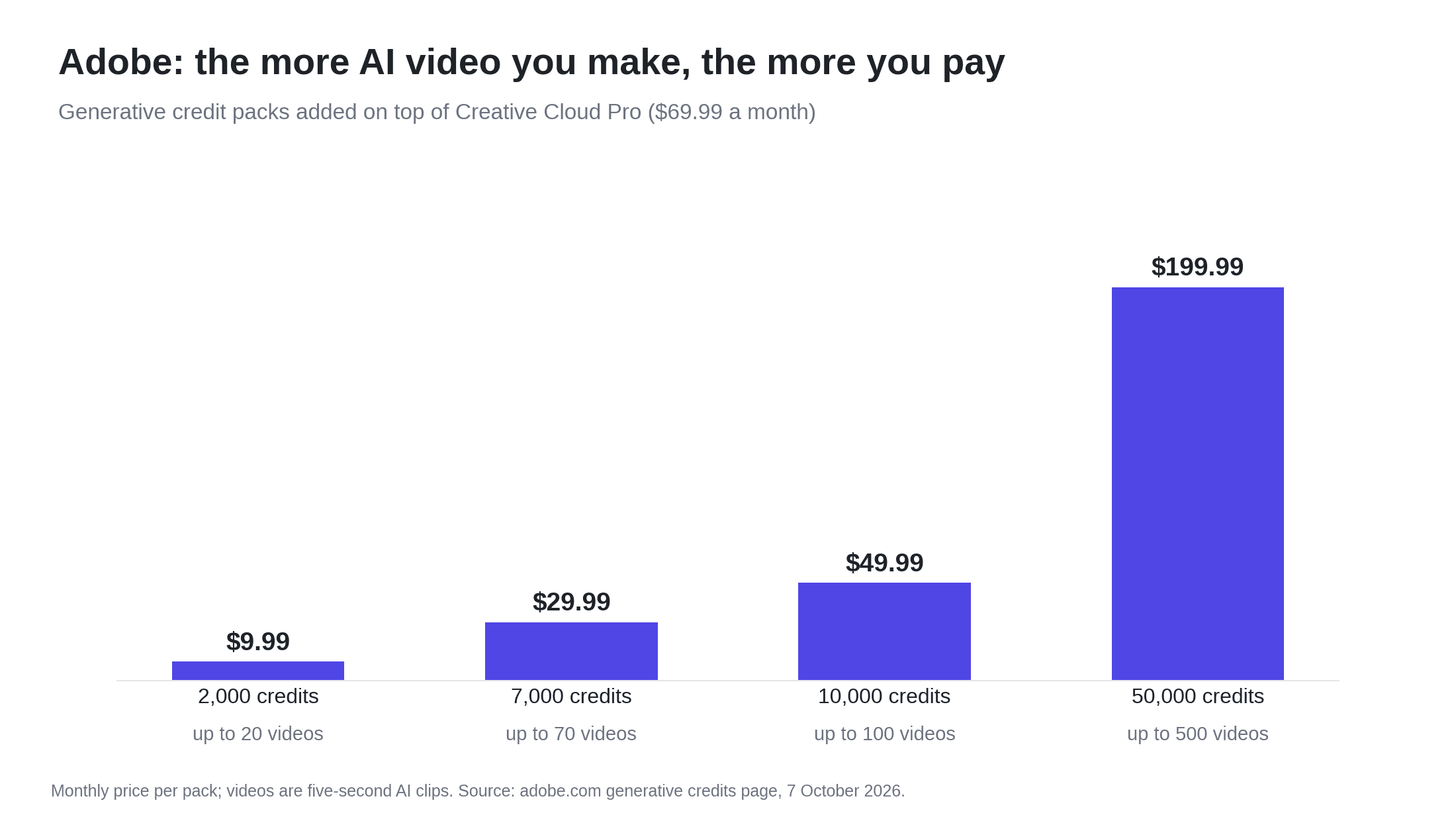
In this image:
Volume barely lowers the unit price. The 50,000-credit pack covers 25 times as many videos as the 2,000-credit pack, yet each video costs only about 20% less ($0.40 against $0.50). With seats, buying more usually earns a real discount. With AI output, cost grows almost in step with use, because every generation has compute behind it.
The add-on can outgrow the software. The smallest pack adds about 14% to a $69.99 subscription; the largest nearly triples it. A team that leans on AI video can soon spend more on credits than on the apps themselves.
That is much harder to answer, especially before a team has used the tool. Adobe at least translates credits into an outcome marketers understand, a five-second video; most vendors leave buyers to convert credits into work themselves. For a marketing team, this means forecasting a new kind of cost. Instead of counting how many people need a login, they have to estimate how many videos, images or campaigns they will produce. Those numbers can swing a lot from one month to the next.
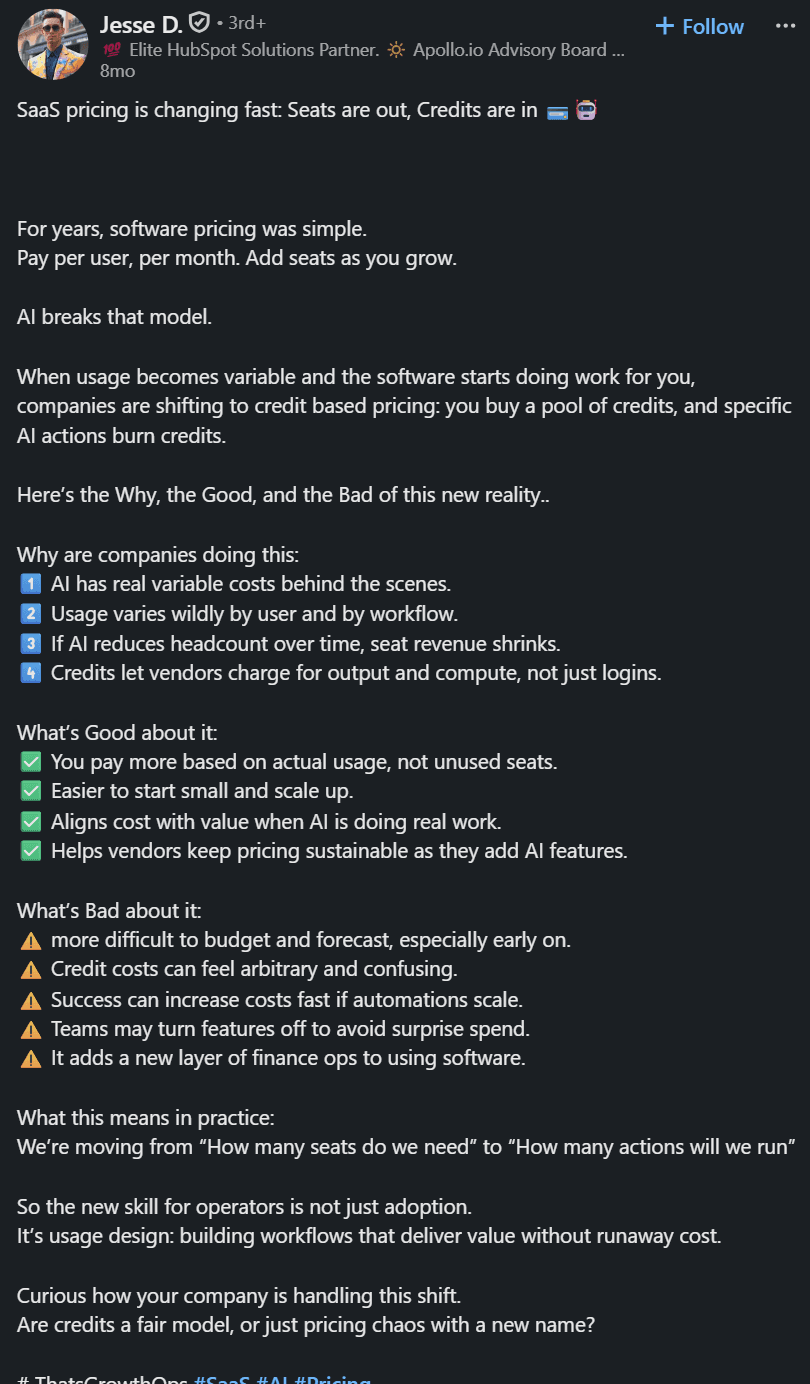
As Jesse D. put it on LinkedIn, buyers are moving from asking how many seats they need to asking “how many actions will we run.”
Finding #4: AI agents are becoming the main price differentiator
Klaviyo charges for AI features and AI agents in different ways. Generative AI for segments, content, flows and images is included in every paid plan. AI agents are sold separately and billed by how much they’re used.
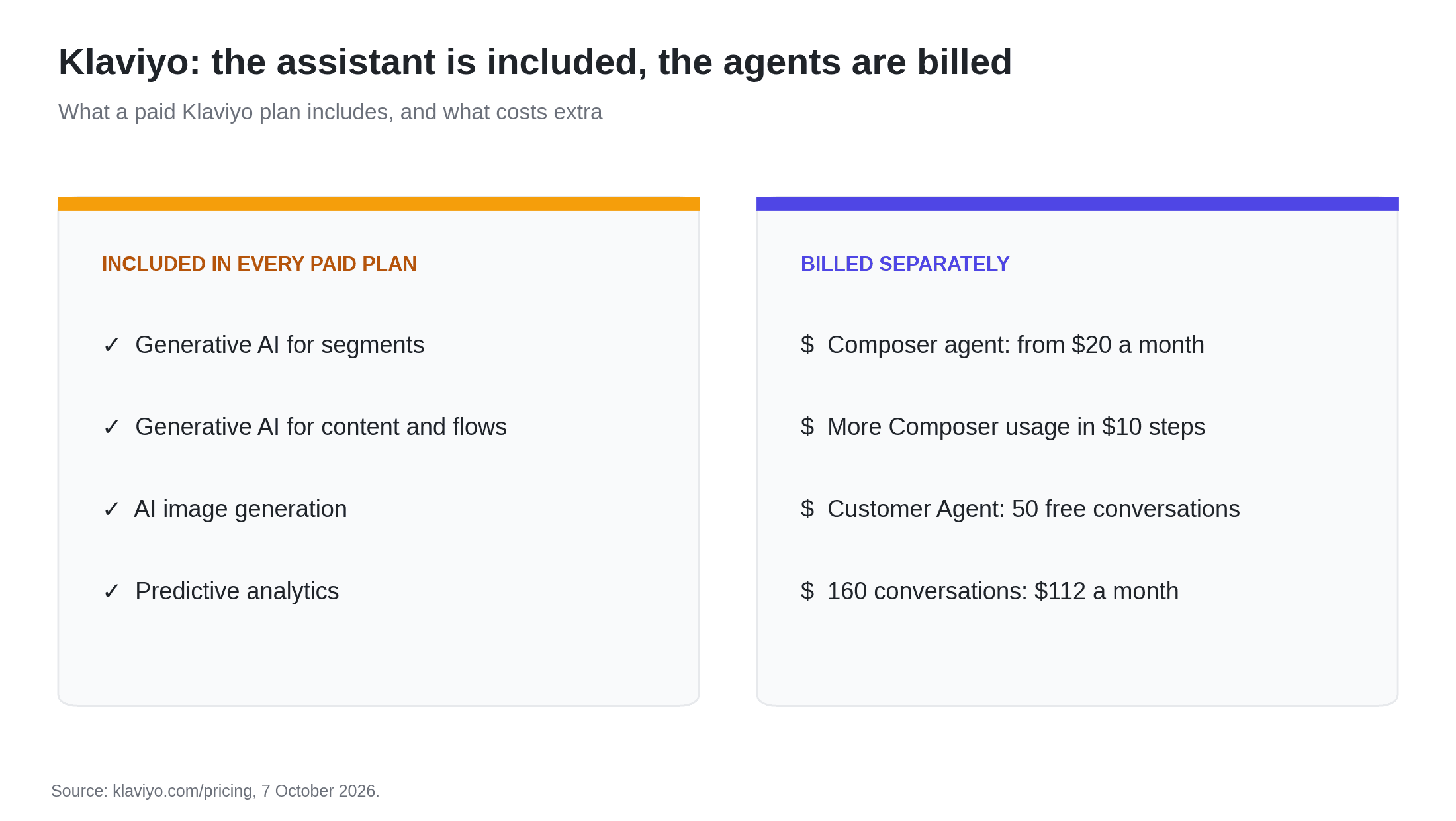
The AI agents sit in their own menu:
Composer, an agent that analyses accounts and builds campaigns, is listed at $20 a month, with more usage sold in $10 increments. Free accounts get $5 of usage a month.
Customer Agent, which answers shoppers and recommends products around the clock, includes 50 free conversations. On Klaviyo's calculator, 160 AI conversations a month cost $112.
If you look at the pricing, Customer Agent costs about 70 cents a conversation after the free allowance, so the bill tracks the work done, not how many people using the software. And it invites a different comparison.
This is a different way to price software. A subscription charges for access: you pay the same amount whether you use the tool a lot or a little. Customer Agent charges for each conversation it handles, which is closer to how a business pays for outsourced customer support than for software.
So the question for buyers is no longer whether the agent is worth more than the subscription, but whether it is cheaper than having a person answer those questions.
At small scale, the gap with the core product is striking. Klaviyo’s email plan starts at $20 a month for up to 500 active profiles, while 160 agent conversations a month cost $112, more than five times as much. For a growing store, the agent, not the platform, can quickly become the bigger bill.
Companies building agents share the same case. Caleb Harris, founder of &AI, argues that seat-based pricing “was built for traditional SaaS,” while every AI prompt carries a different cost.
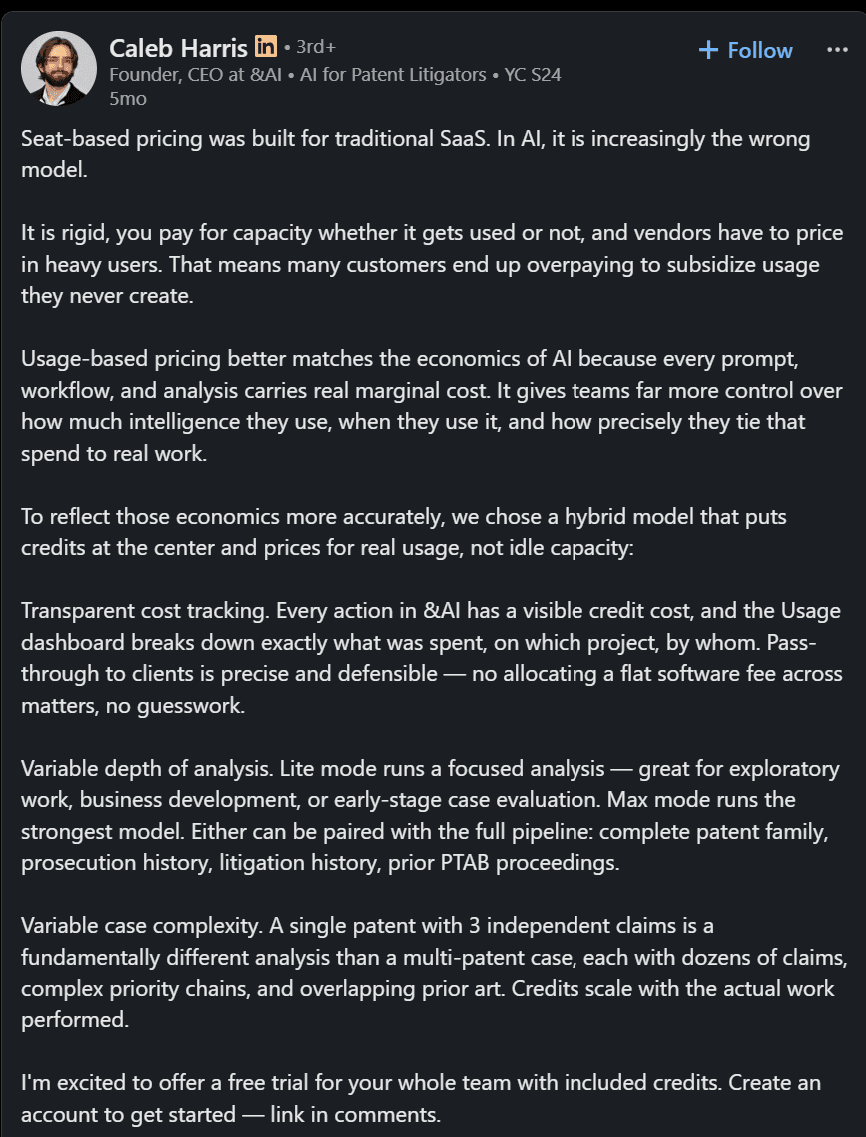
A vendor’s view: &AI sells a credit-based product.
Finding #5: AI visibility is becoming its own product
Semrush now sells “SEO” and “SEO + AI Search” plans. The $117.33 SEO plan excludes AI search tracking. Starter, at $165.17, costs 41% more and tracks 50 prompts a day across Google’s AI results, ChatGPT, Gemini and others.
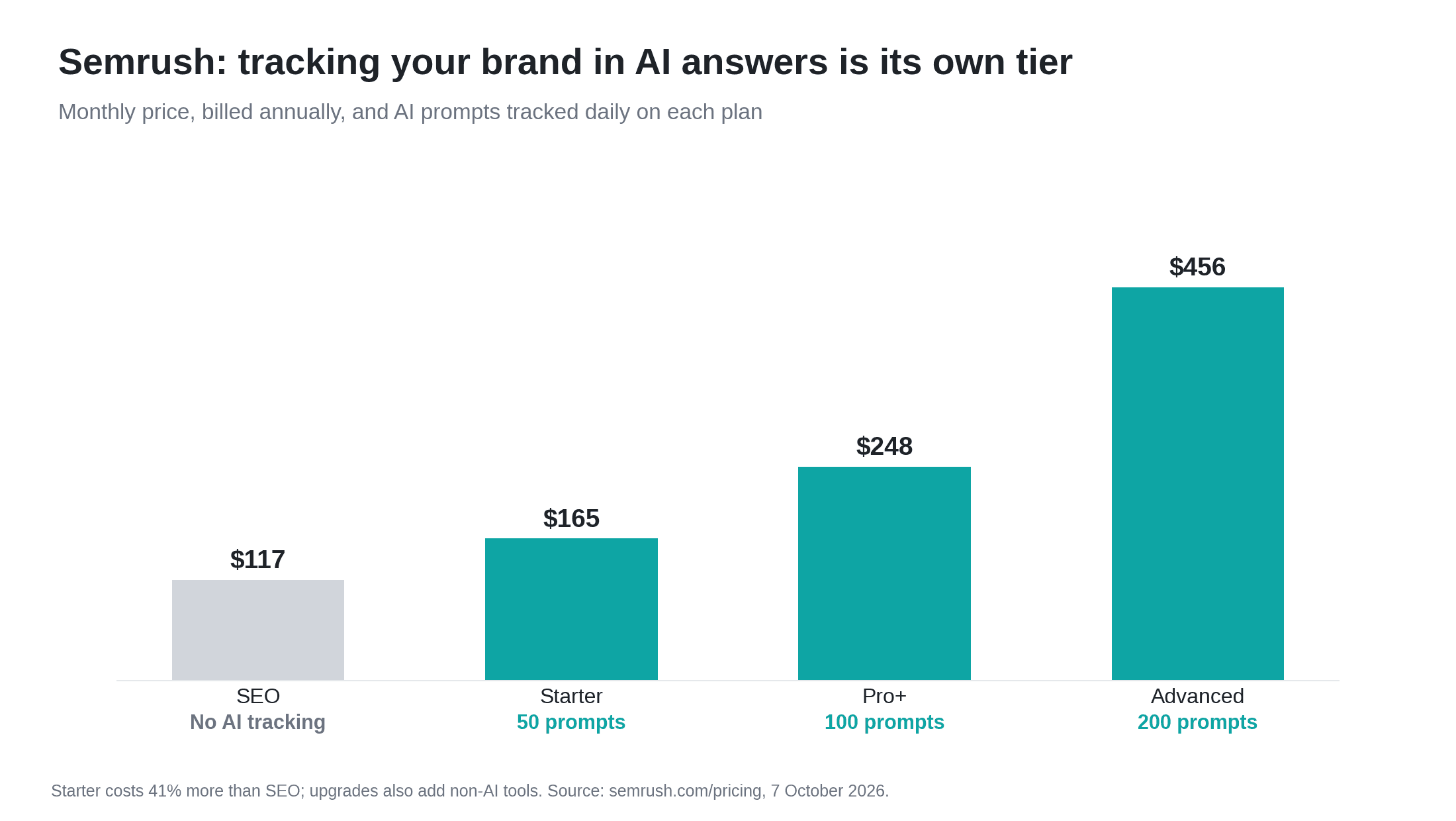
What the extra $48 buys is revealing. The SEO and Starter plans track the same 5 websites and 500 keywords a day. The step up adds fuller keyword research and competitor tools, MCP access and AI visibility tracking, but no extra SEO capacity. The upgrade is mostly about AI search.
This is a different kind of AI spend. In the first four findings, marketers pay to use AI. Here they pay to see how AI talks about them. Since Semrush launched this split in October 2025, measuring a brand’s presence in AI answers has started to become a budget line of its own, next to SEO rather than inside it.
So how much more are marketers paying?
Based on all the tools we analysed we categorised into three layers and each has there own patterns:
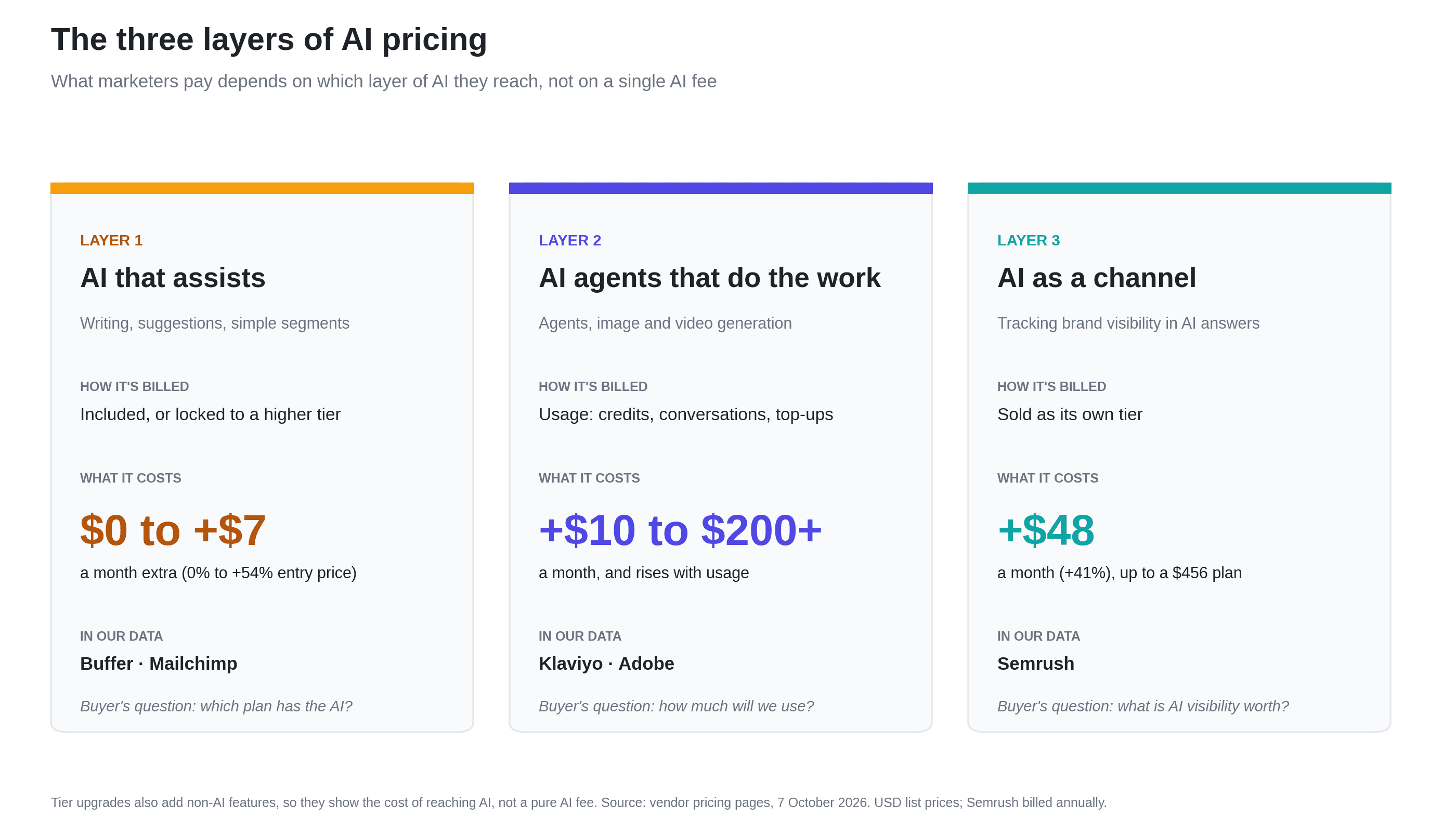
Looking across all five tools, the pattern we see is that the charge for AI depends on how much it costs them to run and how much work it does for the customer:
Cheap AI features are promoted as a bundle or a gateway to higher plans. Writing help, suggestions, and simple segments cost little to run and are easy for competitors to copy, so vendors include them in the plan.
AI agents that do real work are metered. Video, customer conversations, and campaigns each have a real cost behind them, so vendors charge by usage.
AI is becoming a channel to measure. Vendors are building new products that track how AI tools talk about a brand.
For most teams, the harder problem is predictability. A flat plan has a known cost; a credit-based one is known only at the end of the month. AlixPartners warns that metered AI can create a “taxi meter” effect, where people hold back on using a tool to avoid the bill, and Jesse D. lists the same risk: teams switching features off to avoid surprise spend. That is the opposite of what a vendor or a buyer wants from AI. One buyer on Reddit’s r/SaaS put it plainly: “The annoying part is not paying more. It’s not knowing what a normal month is supposed to look like.”
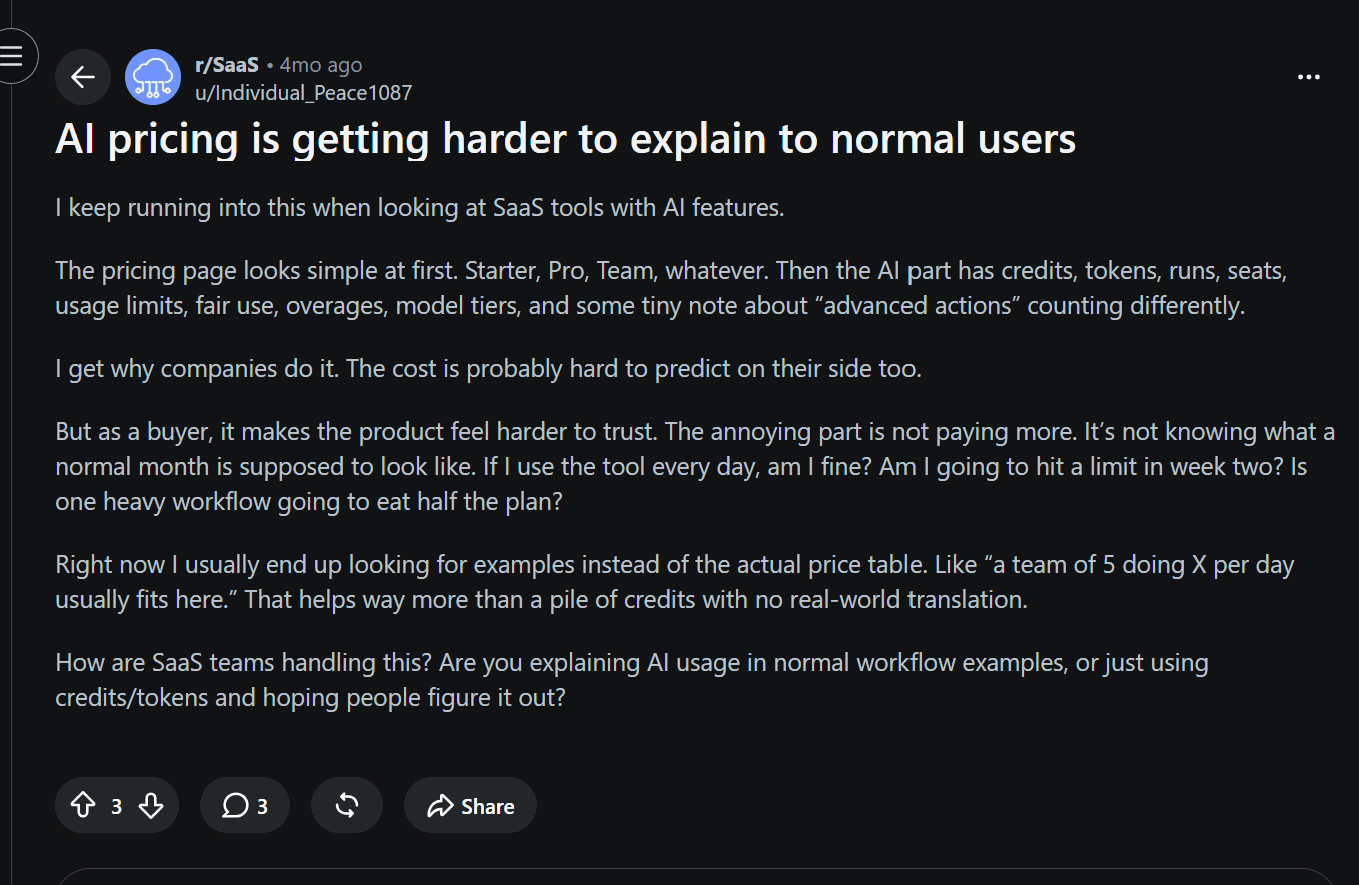
Tips for budgeting AI in your marketing tools
Because the AI premium depends on how much you use it, the price list is only a starting point. These tips will get you closer to the real cost:
Check whether you’d upgrade anyway. If a higher plan’s non-AI features are worth it on their own, AI on that plan is effectively free. If not, the price gap is what you’re paying for AI.
Ask what one unit of work costs. Get the vendor to translate credits into outcomes, like one video, one campaign, or one customer conversation, the way Adobe and Klaviyo do.
Budget for your busiest month. AI rarely gets much cheaper as you use more of it, so plan around a peak month, not an average one.
Don’t assume free AI stays free. More than a quarter of software companies in Nalpeiron’s survey have AI features they don’t charge for separately yet. Check how the vendor’s AI pricing has changed before you rely on it.
FAQs
Which tool is best for small businesses?+
Mailmodo, Buffer, and Hootsuite are affordable and user-friendly, making them great for small businesses just starting with digital marketing.
Can I switch tools as my business grows?+
Yes! Most platforms, like HubSpot and SEMrush, offer scalable plans that grow with your business.